Weber number
\(We = \frac{\rho V_0^2 D_0}{\gamma}\)
Higher values indicate stronger inertial forcing relative to surface tension.
SL theory drop impact calculator
A cleaner interface for reading the core idea first, then evaluating how \(We\) and \(Oh\) set the Reynolds number, impact regime, and predicted maximum spreading.
Overview
Drop impact on a rigid surface depends on the droplet velocity, size, and material properties. This calculator focuses on the two dimensionless control parameters that organize the scaling theory: the Weber number \(We\), which compares inertia and surface tension, and the Ohnesorge number \(Oh\), which measures viscous effects.
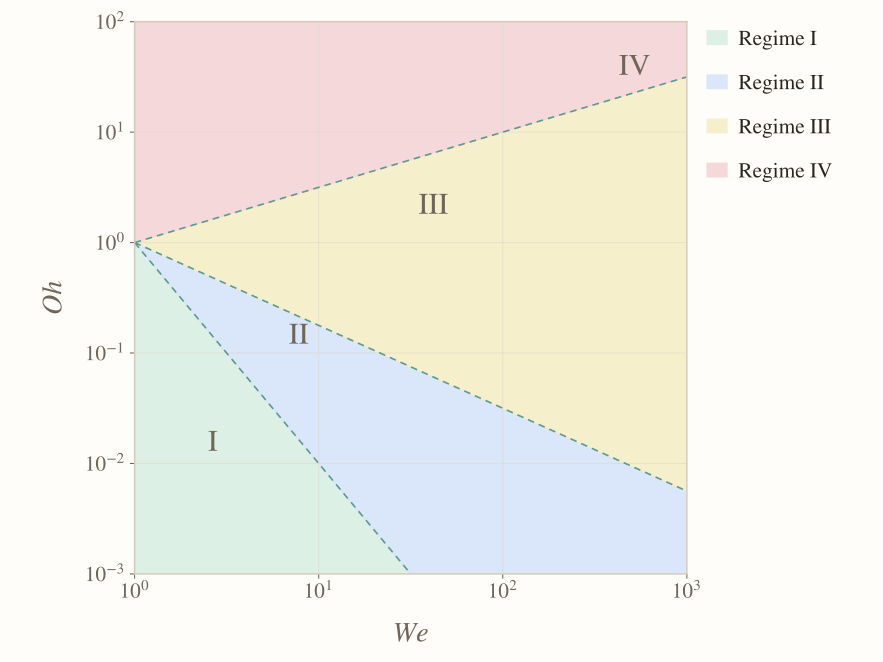
The theory is built from direct numerical simulations spanning \(1 \leq We \leq 10^3\) and \(10^{-3} \leq Oh \leq 10^2\). It separates the dominant dissipation mechanisms across the impact process and predicts the maximum spreading diameter while clarifying why viscous dissipation remains important even at low \(Oh\).
Inputs
Weber number
\(We = \frac{\rho V_0^2 D_0}{\gamma}\)
Higher values indicate stronger inertial forcing relative to surface tension.
Ohnesorge number
\(Oh = \frac{\mu}{\sqrt{\rho \gamma D_0}}\)
Higher values indicate stronger viscous influence during impact.
Phase diagram
Talk
Batch
Upload a CSV with We and Oh header
columns. The model fills in beta as the third
column for every row and returns the completed file.
Preview — first 10 rows